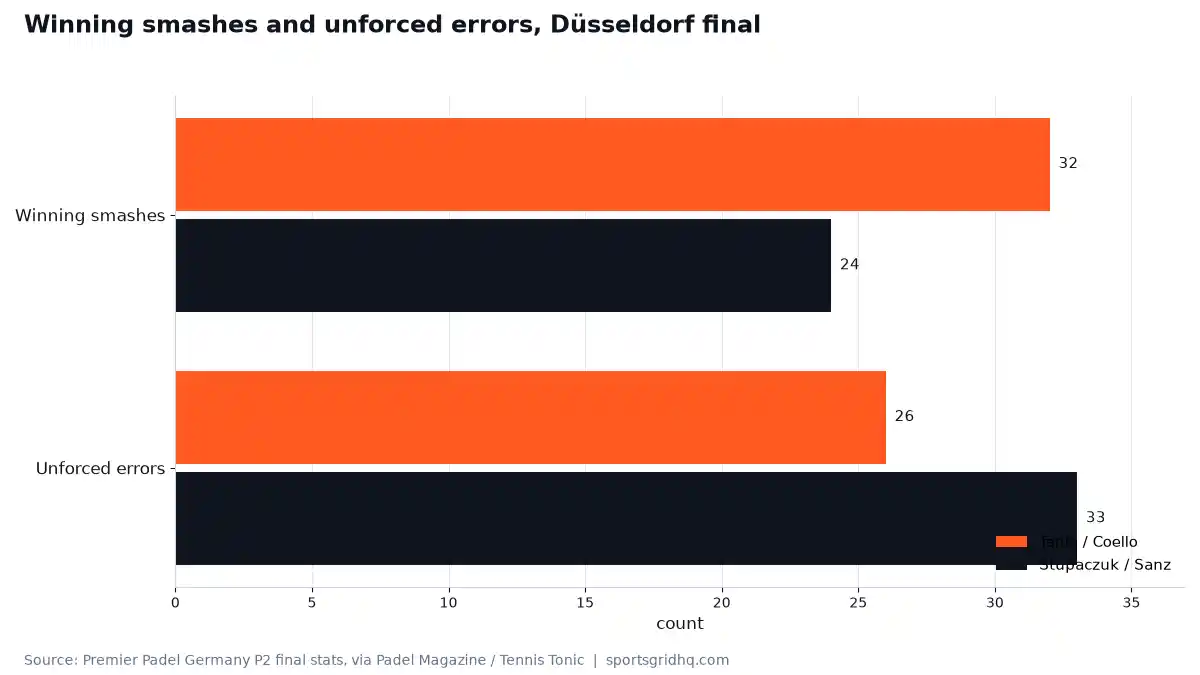
Thirty-two winning smashes to 24. Twenty-six unforced errors to 33. Those two numbers, more than the 6-2, 7-6(5) scoreline, explain why Arturo Coello and Agustín Tapia are still unbeaten in finals against Franco Stupaczuk and Jon Sanz.
The pairing met for the second week running on 11 October in Düsseldorf, in the final of the Premier Padel Germany P2 at CASTELLO Düsseldorf. It was a repeat of the Rotterdam final seven days earlier, and the result was the same: a win for the world number ones, their third tournament title in a row and the 11th of their 2026 season.
What changed was the resistance. Stupaczuk and Sanz broke serve immediately and led 2-0 in the first set before Arturo Coello and Agustín Tapia then won six straight games, took the opening set and eventually closed out a 6–2, 7–6 victory in 84 minutes. The pattern held into the second set, where the challengers served for it at 5-6 before losing the tiebreak.
The key numbers from Düsseldorf
Player
Pair
Distance covered (m)
Sprints completed
Agustín Tapia
Tapia / Coello
1,736
57
Arturo Coello
Tapia / Coello
1,830
77
Franco Stupaczuk
Stupaczuk / Sanz
1,992
68
Jon Sanz
Stupaczuk / Sanz
2,361
124
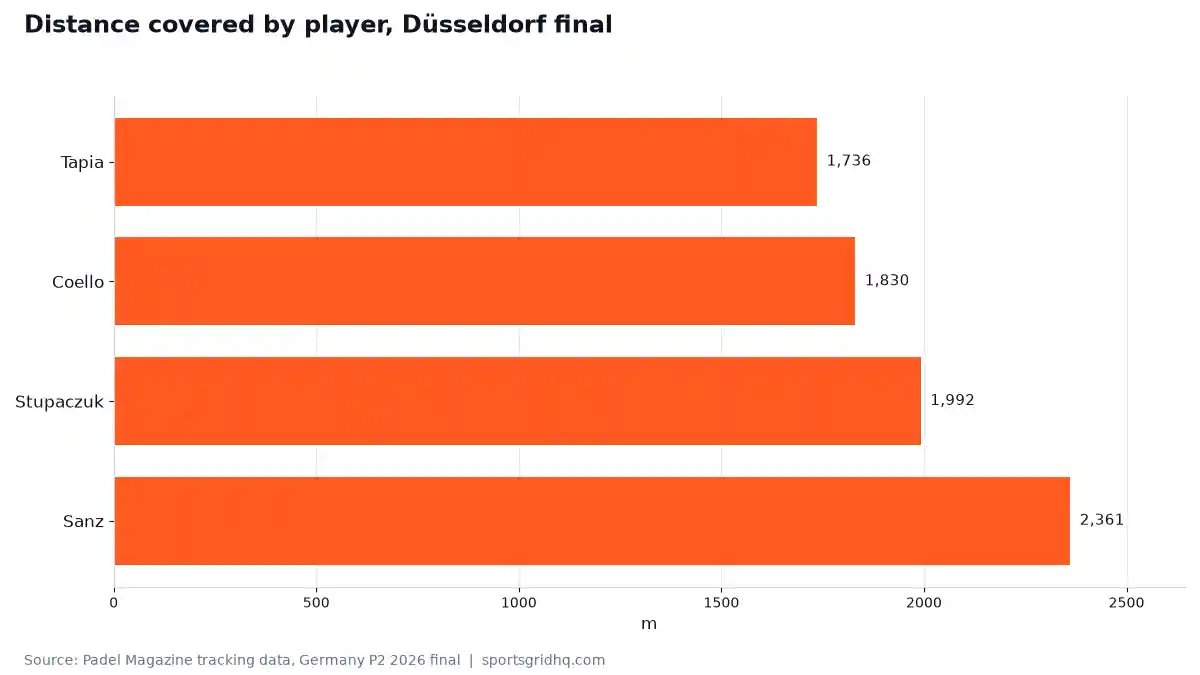
The distance figures come from Franco Stupaczuk (1.992 metros), Arturo Coello (1.830 metros) and Agustín Tapia (1.736 metros), with Sanz covering 625 metres more than Tapia during the match. Sprint counts tell a similar story: Jon Sanz completed 124 sprints, Arturo Coello 77, Franco Stupaczuk 68 and Agustín Tapia 57, which works out to 5 sprints per minute for Sanz, compared with 3.1 for Coello, 2.7 for Stupaczuk and 2.3 for Tapia.
Why the smash count is the real headline
In padel, a winning smash (sometimes called a “remate” in Spanish-language coverage) is an overhead shot hit hard enough to end the point outright, usually after the attacking pair has pushed their opponents back with a lob. It is the clearest marker of who controlled the net, because you can only hit a put-away smash if you are already standing at the glass with the ball sitting up for you.
Coello and Tapia recorded 32 winning smashes to 24 for Stupaczuk and Sanz, while committing 26 unforced errors against their opponents’ 33. An unforced error, here, means a shot lost with no real pressure applied by the opponent, the kind of mistake a pair makes when it is rushed or out of position rather than beaten by a clean winner.
Put those two figures together and you get a pair finishing more points on their terms while giving away fewer for free. On paper, that is close to the simplest explanation of a padel scoreline that exists: more clean winners, fewer gifts.
Winning smashes and unforced errors, Düsseldorf final
What the running data adds
The physical numbers back up the tactical picture rather than contradicting it. Jon Sanz’s extra distance and his sprint count nearly double Tapia’s are not a sign that Sanz was dictating play. They point the other way: a player chasing down more lobs and covering more width usually does so because he is defending, not attacking.
High-speed running distance, defined by the tracking data as ground covered at more than 2.5 metres per second, reinforces that reading. Sanz covered 1,016 metres at more than 2.5 metres per second, against just 526 metres for Tapia. Across the whole match, Tapia and Coello covered 3,566 metres between them, against 4,353 metres for Sanz and Stupaczuk, a gap of 787 metres.
The data shows a clear split: one pair spent more energy retrieving and defending, the other spent it closer to the net, finishing points. A likely reading is that Coello and Tapia’s net positioning forced Stupaczuk and Sanz into longer, more frequent chases for lobs, particularly down Sanz’s right side, which is exactly the kind of running pattern that shows up as extra sprints and extra metres on a tracking sheet.
Distance covered by player, Düsseldorf final
A rivalry still finding its shape
Stupaczuk and Sanz are a new partnership by elite padel standards, formed in 2026, and their head-to-head with the world number ones is still short. Arturo Coello and Agustin Tapia lead Jon Sanz and Franco Stupaczuk 2–0 in 2 meetings since 2026, having met in 2 finals, both won by Coello and Tapia. Across those two matches the gap in sets is 4–0 and games 25–13, which lines up with Düsseldorf being the tighter of the two contests.
That is not the full picture of Stupaczuk’s history against this pairing, though. Across his various partnerships, including the years alongside Martín Di Nenno, Stupaczuk has faced Coello and Tapia far more often: in 15 meetings against Stupaczuk / Di Nenno, Coello and Tapia have won 11, a 73% rate. Seen in that longer context, Düsseldorf fits a pattern that goes back years rather than a one-off.
None of that means the new pairing has stalled. Their run has included a final at the FIP Platinum in Lyon and finals in Rotterdam and Düsseldorf, along with back-to-back wins over Galán and Chingotto, the pair most observers still rank as the clearest challengers to the number ones. Beating Alejandro Galán and Federico Chingotto in the semi-finals of two straight P2 events, then taking a set off the top pair in a final, is a reasonable definition of progress even without a trophy to show for it.
For Coello and Tapia, Düsseldorf extended an already long run. Their latest success was their 11th title this year and 58th as a team, and in 2026 they have compiled a 70-7 win-loss record as a pair. Zoom out further and together they have won 349 of their 382 matches, a 91.36% win rate since February 2023, a number that puts a single final into perspective: this is less an upset-in-waiting and more a pair operating at a level few partnerships in any racket sport sustain.
What it means
The Düsseldorf numbers describe a specific pattern rather than a permanent ceiling. Stupaczuk and Sanz defended more ground and ran harder, which kept the second set alive into a tiebreak, but they still finished with fewer winning smashes and more unforced errors.
A likely reading is that the gap between the two pairs is currently built on net control rather than raw athleticism. Sanz covering more distance and sprinting more often shows effort and physical capacity, not a tactical advantage, since all that running was largely defensive. Closing the gap for Stupaczuk and Sanz probably means finding ways to contest the net earlier in the point, rather than just chasing down more lobs once they are already defending.
What to watch
Both pairs are back in action immediately. The Milano Premier Padel P1 is the 20th event of the 2026 Premier Padel season, running at the Allianz Cloud, with semi-finals on Saturday 17 October and finals on Sunday 18 October. The 2025 edition of the event drew 35,473 spectators, a reminder of how much the Milan stop has grown since Premier Padel’s early seasons.
The men’s draw has already split some of the leading pairs apart: Galán and Chingotto landed on the same side of the bracket as Juan Lebrón and Leo Augsburger, while Coello and Tapia sit elsewhere in the field. Whether Stupaczuk and Sanz can reach a third straight final against the world number ones will depend on how both pairs move through their own quarters of the draw over the coming days.
Worth tracking regardless of the result: whether Sanz’s running totals drop if Stupaczuk and Sanz find more net time earlier in points, and whether Coello and Tapia’s smash-to-error ratio holds up against a different style of opponent than the one they have now beaten in back-to-back finals.