
Rules and facts last checked on 7 October 2026.
Local councils from Connecticut to County Tipperary are currently weighing planning applications for padel courts, on old industrial sites, former football pitches and country-house lawns. Every one of those builds, wherever it ends up, has to answer to the same four walls and a net that a Mexican businessman improvised in his garden more than half a century ago.
That improvisation is now the most codified part of the sport. The International Padel Federation (FIP) publishes exact tolerances for the glass, the mesh, the net and the ball, and those numbers explain almost everything about how padel is played, right down to which side of the court you should stand on.
A duck-hunting ground, a missing tennis court, and a fence that stuck
The first official padel court was built in Acapulco in Mexico by Enrique Corcuera in 1969. Corcuera wanted a racket sport on his property, but there wasn’t room for a full tennis court, so he built something smaller and worked around the space he had.
Corcuera enclosed the court using walls to keep the ball in play, making the walls part of the game rather than a boundary to avoid, which is the idea that separates padel from every other racket sport. He surrounded the court with walls and a metallic fence of up to four metres on all sides, designed to stop the ball escaping onto his neighbour’s land. The rules weren’t an afterthought either: the first set of rules for padel was written by Corcuera’s wife, Viviana, establishing the format that survives today: an enclosed court, an underarm serve, and tennis scoring.
The sport didn’t stay in Mexico for long. The game arrived in Spain in 1974 and Argentina in 1975. Spain’s route in was aristocratic rather than grassroots: a friend of Corcuera’s built the first European courts at his hotel on the Costa del Sol and the idea spread from there through Spanish high society before reaching clubs.
Padel’s governing structure caught up decades later. The International Padel Federation was formed in 1991 and the first recognisable professional tour followed in 2005, long after amateur players across Spain and Argentina had already worked out their own version of the rules Viviana Corcuera first wrote down.
What the FIP rulebook actually specifies
The sport’s current Rules of Padel, published by the FIP, read less like sporting poetry and more like a construction manual. That’s the point: a padel court behaves consistently anywhere in the world only because the specifications are tight.
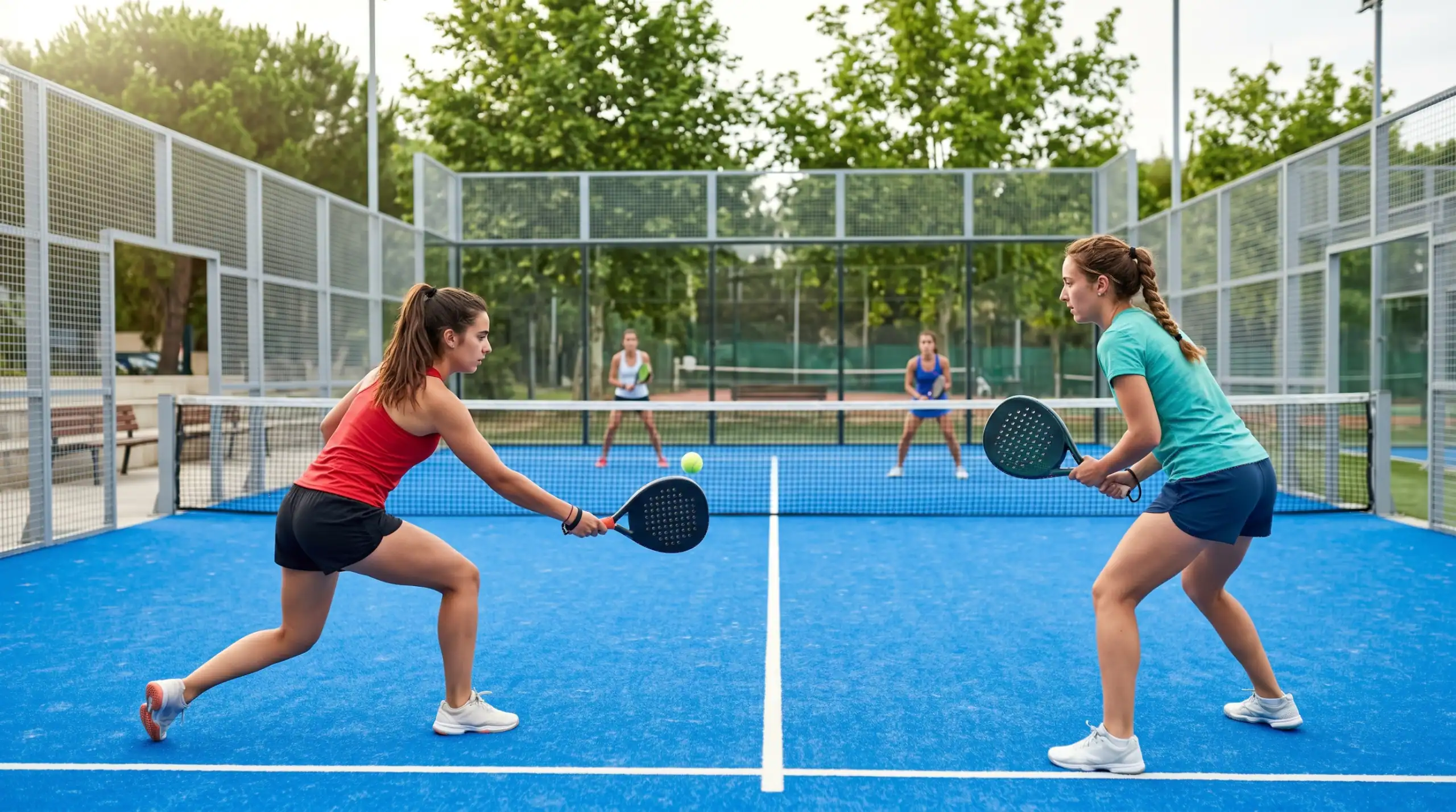
A regulation court is a 10 m by 20 m rectangle measured inside the enclosure, with a 0.5% tolerance, and a net divides it into equal halves. The court is fully enclosed, with end enclosures 4 m high, normally made of a 3 m wall topped by a 1 m metallic fence. Minimum height throughout the court must be 6 metres, and for new facilities the FIP suggests a minimum free height of 8 metres, with no obstructions in that space.
The net gets its own precise numbers too. It must be 10 metres long and 0.88 m high at the centre, rising to 0.92 m at the ends, with a maximum tolerance of 0.005 m. That slight sag toward the middle, just 4 cm lower than the edges, rewards players who can thread the ball down the centre line, which is one reason the middle of the court matters so much tactically.
Even the ball and racket are regulated down to the millimetre. The ball must be a rubber sphere with a uniform exterior surface, a diameter between 6.35 and 6.77 cm and a weight between 56.0 and 59.4 grams. Its internal pressure must sit between 4.6 kg and 5.2 kg per 2.54 square cm. A padel racket’s head plus handle may not exceed 45.5 cm in total length, with a maximum width of 26 cm and a maximum thickness of 38 mm.
| Element | Official measurement | Why it’s set there |
|---|---|---|
| Playing area | 20 m × 10 m (±0.5%) | Keeps every court interchangeable for competition |
| Net height | 0.88 m centre, 0.92 m at posts | Lower than tennis, encourages net play and volleys |
| Back wall | 3 m glass + 1 m mesh (4 m total) | Glass gives predictable rebounds, mesh saves cost up high |
| Minimum ceiling (indoor) | 6 m, 8 m recommended for new builds | Clears the lob and smash without hitting roof structures |
| Ball diameter / weight | 6.35–6.77 cm / 56.0–59.4 g | Controls bounce consistency across altitudes and temperatures |

Lined up against tennis and squash, padel sits in between: smaller than a tennis doubles court but far bigger than a squash box, and the only one of the three where the walls are legally live for rallies rather than just the serve or the out-of-bounds marker.
Why the glass is legal and what that changes
The rule that actually makes padel padel is simple to state and tricky to master: after the ball bounces once on the court surface, a player may let it carry into the back or side glass and play it off the rebound, as long as it hasn’t bounced twice on the ground first. Hit it into the glass before it bounces on the court, though, and the point is lost, which is why professional rallies often look like players are waiting a beat longer than instinct suggests before committing to a shot.
That single rule turns defence into an attacking option. A ball that would be a clean winner in tennis can come back from the back wall in padel, which is part of why rallies run longer and why the sport rewards patience as much as power.
Right side, left side: the position rule every beginner asks about
Padel is always doubles, and unlike tennis there’s no rule forcing players to alternate sides within a game beyond the serving pattern. In practice, pairs settle into a right-side and left-side player and mostly stay there for the whole match.
The right-side player is known in Spanish, the language most of the professional tour speaks, as the drive, or jugador de derecha, while the left-side player is the revés, meaning backhand. For two right-handed players, those labels aren’t just names, they describe exactly which shot each player hits down the middle.
For two right-handers, the left-side player has the forehand facing the middle of the court while the right-side player has the backhand there, so most balls down the centre, along with most of the drifting lobs and overheads, belong to the player on the left. That’s a direct consequence of standing to the left or right of a central service line, nothing more mystical than which hand holds the racket.
The scoring system then layers extra meaning onto the choice of side. The right-side player returns serve at 0-0, 15-15, 30-30 and 40-40, while the left-side player returns at every other score, including 15-0, 30-15, 40-30 and every advantage, meaning a large share of game points and break points land on the left. Nothing in the rules forces anyone to stand anywhere specific, but after decades of professional padel a clear pattern has settled in: the right side builds the point, and the left side finishes it.
| Side | Spanish term | Shot facing centre (right-hander) | Typical tactical job |
|---|---|---|---|
| Right | Drive / derecha | Backhand | Consistency, defending the back glass, setting up the point |
| Left | Revés | Forehand | Finishing with smashes, overheads and bandejas down the middle |
Left-handed players flip the logic entirely, which is why mixed-handed pairs are prized at every level: a lefty on the right side gets a forehand down the centre too, doubling a team’s attacking options through the middle.
From a private garden to 77,300 courts
Padel’s growth is the easiest part of this story to put numbers on, and the figures move fast enough that it’s worth stamping a date on them. In 2014, the World Padel Tour estimated roughly 12 million players globally; by the end of 2024 that figure had climbed to approximately 30 million.
The most recent official count comes from the governing body itself. According to the FIP World Padel Report 2025, active padel players exceed 35 million globally, with clubs up 16.1% to 24,600 and courts up 15.2% to 77,300, spanning 150 nations. Europe accounts for 61% of players, while women represent 40% of participants.
The FIP now counts 100 member national federations, more than triple the roughly 30 it had in 2019. Not every tracker agrees on the precise scale: an independent industry report for 2026 put the global total closer to 58,334 courts and 19.4 million players using narrower, booking-platform-based criteria, a reminder that “player” and “court” get counted differently depending on who’s doing the counting.

Where to go next
Read the FIP’s own rulebook if you want the version with no interpretation layered on top, it’s shorter than most sports’ equivalents and settles any argument about a let serve or a ball clipping the frame of the door. If you’re picking a side for the first time, try both for a session before committing: the right side is more forgiving while you learn to read the glass, and the left side will teach you the overhead smash faster than any coaching drill. And if a new court is going up near you, on a brass-factory site, a football pitch or a country-house lawn, it will be built to the same 20×10 metre box that Enrique Corcuera stumbled into by accident in 1969.
Sources
- Source: Rules of Padel, International Padel Federation
- Source: FIP World Padel Report 2025
- Source: History of padel, LTA Padel
- Source: The History of Padel: When It Was Invented and How It Spread, Padel Market
- Source: Padel positions explained: who plays right, who plays left and why, Red Bull
- Source: Padel players exceed 35m globally as courts rise 15% in 2025, SGI Europe
- Source: Padel Worldwide Growth: The Data Behind The Boom, TrustPadel
- Source: Official Padel Rules (FIP): 2026 Summary and Practical Guide, padel.how