
Specs and prices last checked on 29 October 2026.
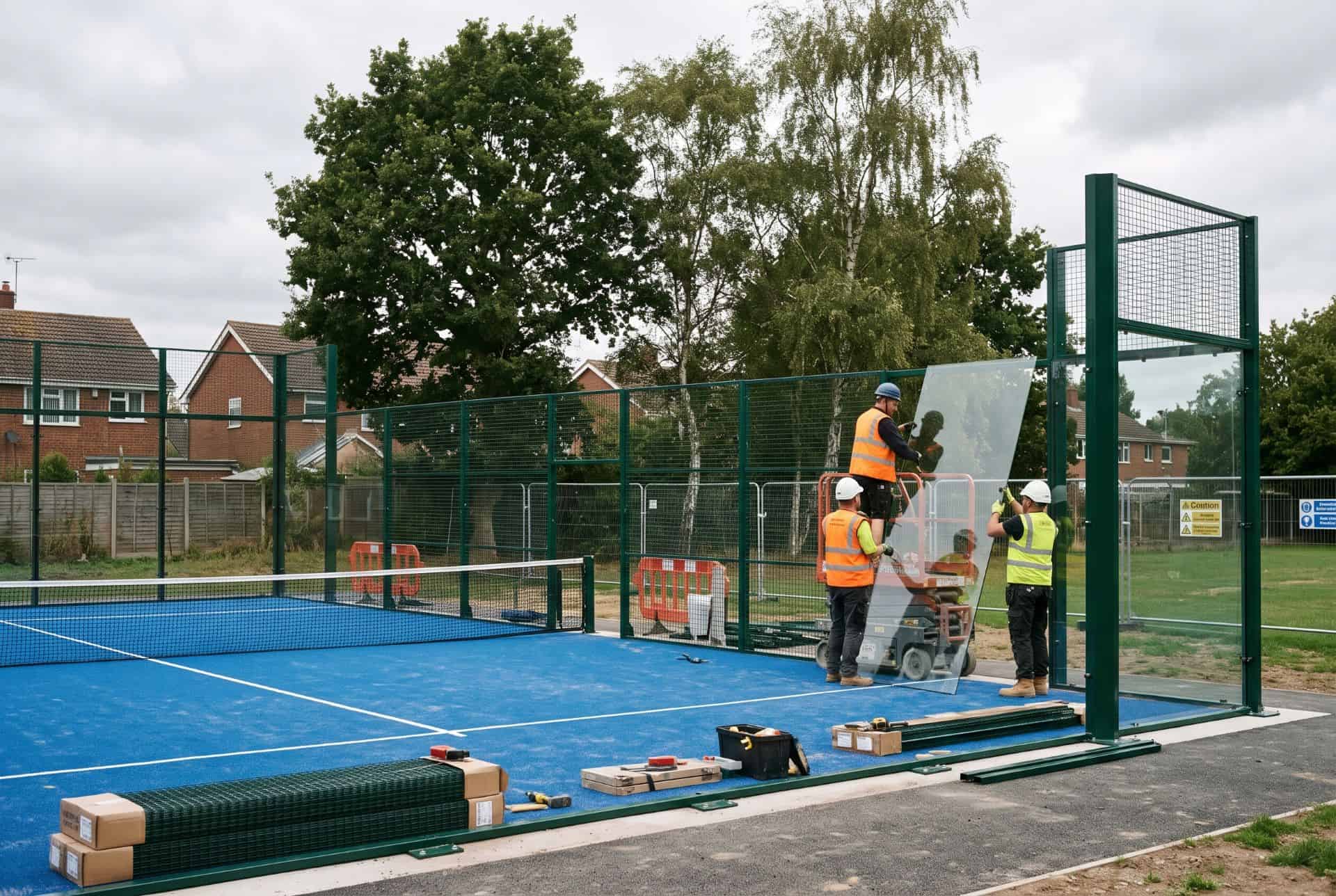
Telford Tennis Centre opens its padel courts officially on Sunday 1 November, and the paperwork behind them is a decent window onto how courts get built in Britain right now. The courts are the result of a partnership between Telford & Wrekin Council and We Do Tennis. I haven’t visited, so what follows is a read of planning papers, council statements, the FIP rulebook and published acoustic studies.
What the FIP rulebook fixes
Every homologated court starts from the same box. The FIP rules describe a rectangle 10 metres wide by 20 metres long, measured on the inside, with a 0.5% tolerance. One reference site works that out as 10 cm of give on the length and 5 cm on the width.
Height matters as much as floor area, particularly for anyone converting a shed. The rules ask for at least 6 metres of clear height with nothing obstructing it, such as spotlights, and suggest 8 metres for new facilities.
| Element | Figure | Note |
|---|---|---|
| Playing area (m) | 20 × 10 | 200 m² of playing area |
| Net height, centre / ends (m) | 0.88 / 0.92 | Net is 10 m long |
| Back wall (m) | 4 | First 3 m glass or another solid material, top 1 m metal mesh |
| Glass thickness (mm) | 10 to 12 | Toughened safety glass; 12 mm is described as the standard for heavily used venues (reference site, not the FIP) |
| Clear height (m) | 6 minimum, 8 suggested | FIP suggestion for new facilities |
| Plot per court (m) | about 22 × 12 | Planning allowance including structure and circulation space (reference site) |
The floor can be cement, synthetic or artificial grass, according to the FIP 2026 rulebook as summarised by Padeli. The same source points out that a tennis doubles court is about 260 m², so a padel court is closer to 77% of that footprint, which makes the “a third of a tennis court” line that BBC copy still repeats look generous to the sport’s neighbours.
Telford: three courts, stacked containers and a slipped deadline
The Telford scheme went through planning as 2 covered doubles courts and 1 uncovered singles court, with space for retail, a viewing area, changing rooms and a café. It replaces two tennis courts. The council newsroom listed it as a covered-courts project, while a later local report mentioned indoor courts, so the exact enclosure is worth checking on a site visit.
One planning detail stands out. Council officials raised concerns about stacked shipping containers supporting the covered structure, and the plan was approved once planners resolved them. Containers are a quick, modular way to hold up a roof, and they explain how a build can move fast once consent arrives.
The timeline is easy to follow. The November 2025 partnership announcement promised covered padel courts, subject to planning, ready from summer 2026. The application was published on 2 April 2026, building work was reported as started on 16 October, and the official opening is 1 November. That is roughly four months later than first envisaged.
On money, We Do Tennis committed to a major capital investment, but none of the sources I found gives a cost. Booking is through the Padel Mates app, with prices from £20 to £28 per hour; the report doesn’t say whether that is per court or per player. The operator’s planning case projected staffing rising from one full-time employee and seven self-employed coaches to about four full-time employees and up to ten coaches.
Glasgow: £500,000 and 79 objections
A bowling club in Pollokshields shows the other end of the funding spectrum. Three padel courts have been approved there despite 79 objections. The facility is valued at £500,000, and the club’s member secretary told the committee it owns the land footprint and has insufficient funds to continue without new income. The courts go on the site of two old tennis courts.
One resident described the scenario in plain numbers: three courts with up to 12 players and 12 cars at once, from 8 in the morning until ten at night, seven days a week. The arithmetic is simply 3 courts × 4 doubles players. That is the case planners have to weigh against a club’s survival.
What the noise studies measure
Noise is the objection that recurs in almost every file. Two terms first: dB(A) is a sound level weighted to match human hearing; LAeq is the average level over a measurement period, and LAmax is the loudest instant.
One published study recorded a padel court and a tennis court for a single 15-minute period each. At 10 m the padel court reached an LAeq of 64.2 dB(A) and an LAmax of 71.3, against 58.4 and 63.6 for tennis. That is 5.8 dB higher on average and 7.7 dB higher at the peak, from a small sample (one court each), so treat it as indicative.

A separate acoustics consultancy paper reports a similar gap. Measured 5 m from the side of the court, padel averaged 6 dB more than tennis. It also found the level at the side of the court roughly 12 dB higher than at the glass end. The glass back wall, in other words, keeps sound in, while the mesh sides let it out.
Mitigation is where the numbers get slippery. The modelling study predicted facade reductions of 4 to 5 dB(A) at the most shielded positions with 4 m barriers. A barrier maker, by contrast, advertises up to 28 dB for reflective timber designs and up to 32 dB for absorptive ones. Those are product ratings, and the gap between a rating and a result at a bedroom window is the whole argument.
Councils are not uniform. The LTA recommends noise mitigation where homes are less than 30 m from a padel court, a rule one Bath committee record says was met with 3 m glazed screening. At Cinderford, a 3 m translucent screen of at least 12 kg/m² was specified. In Redditch, though, the noise officer’s consultation response said there was no practical mitigation that would make four courts acceptable beside nearby homes. In York, four courts at York Sports Club were refused, and a second scheme at Dunnington was turned down over loss of playing-field land as well as noise worries.
For a yardstick, the Dutch Tennis Association’s guidance, as reported by The Padel Paper, caps noise at 40 to 50 dB over the match and 60 to 70 dB for individual strikes, subject to location and time of day.
Warehouses: the same box, a bigger shell
Noise is easier to contain with a roof and walls, which is one reason the industrial estate is popular. Property consultancy Vail Williams says owners are leasing industrial space to padel operators, and operators want high ceilings, large floor areas and nearby parking. The LTA says UK padel has grown from around 15,000 players in 2019 to one million.
| Site | Courts | Status | Reported detail |
|---|---|---|---|
| Telford Tennis Centre | 3 | Opens 1 Nov | Operator-funded; cost not reported |
| Titwood, Pollokshields | 3 | Approved | £500,000 facility |
| Borron Street, Port Dundas | 4 | Approved | Former industrial unit, with café, shop, lockers and seating |
| Northallerton depot | 6 | Plans submitted | Café, fitness and therapy rooms; North Yorkshire Council considering |
| Lenton Lane, Nottingham | 8 | Approved | 4,200 m² site; 24 full-time-equivalent jobs |
| Fishwick Park, Preston | 10 | Approved | Two vacant units joined; open 6am to midnight |

The footprints tell you more than the court counts. Nottingham’s 4,200 m² for 8 courts works out at about 525 m² each, roughly double the 264 m² plot allowance, because the studio, café and 58 parking spaces share the site. A Milton Keynes proposal from 2025 put four courts in a 20,914 sq ft (about 1,943 m²) building, about 486 m² per court.
Roof height is the other constraint. Nottingham’s separate application to raise the warehouse roof by 3.5 m was approved in 2025; the reports don’t link it to padel, but 6 m of clear height is the sort of number that decides which sheds are usable. On the landlord side, Vail Williams argues padel is a reuse strategy for older industrial buildings and unoccupied retail units that might otherwise need heavy capital spending.
What the paperwork can’t tell you
A planning file gives court counts, hours and mitigation, and a good one gives measured noise. It doesn’t tell you the glass specification, the surface brand, the lighting level on court or how the acoustic modelling will compare with the real thing. Those are the numbers a player or neighbour would want, and they usually surface after opening.
Prices are the other gap. Telford’s £20 to £28 range is the only court rate in this batch, and costs for the Telford and Nottingham builds weren’t reported in anything I found. Treat the £500,000 Glasgow figure as the one hard cost, and note the report doesn’t break it down.
Who it suits
Councils and clubs with tired tennis courts get the clearest case: the replacement route at Telford and Pollokshields puts three courts on a footprint that used to hold two. Warehouse landlords with sheds of 6 m clear height or more can offer operators a quieter envelope and a big car park. Residents within 30 m of an open-air scheme have the best reason to read the acoustic report, and players have the easiest job: check the clear height and the hourly rate, and book.
Sources
- Source: FIP, Rules of Padel (in force as of 1.01.2026)
- Source: Telford & Wrekin Council, Planning submitted for new padel courts at Telford Tennis Centre
- Source: Telford & Wrekin Council, Tennis Announcement for Telford Tennis Centre
- Source: Shropshire Star, New Telford padel courts officially opening this weekend
- Source: Shropshire Star, Work begins on new padel courts at Telford Tennis Centre
- Source: Telford Live, Telford shipping container padel plan passed
- Source: Telford Live, Padel power! More courts planned for Telford
- Source: STV News, New padel courts worth £500,000 approved despite ‘raucous’ concerns
- Source: Yahoo News UK, Landlords turn empty warehouses into padel courts
- Source: TechRound, Padel Is Turning Empty Spaces Into Businesses
- Source: Acoustic characterization and modeling of padel courts in urban residential environments
- Source: May Walters, Padel, Planning and Noise summary paper
- Source: The Padel Paper, How to solve padel’s noise problem?
- Source: Jacksons, Noise reduction for padel courts with acoustic barriers
- Source: Padeli, What are the padel court dimensions?
- Source: Padel Compass, Padel Court Dimensions
- Source: Play For More, Padel Court Dimensions
- Source: Redditch Borough Council, planning report 25/00162
- Source: Bath and North East Somerset Council, committee agenda item
- Source: Clarke Saunders Acoustics, Cinderford RFC padel noise impact assessment
- Source: BBC via AOL, Padel courts proposal rejected over noise fears
- Source: BBC via AOL, Padel courts plan refused over noise concerns
- Source: BBC via AOL, Padel centre plan for empty factory approved
- Source: BBC via AOL, Empty warehouse to become padel centre
- Source: Estates Gazette, Indurent pivots to padel for empty warehouse