
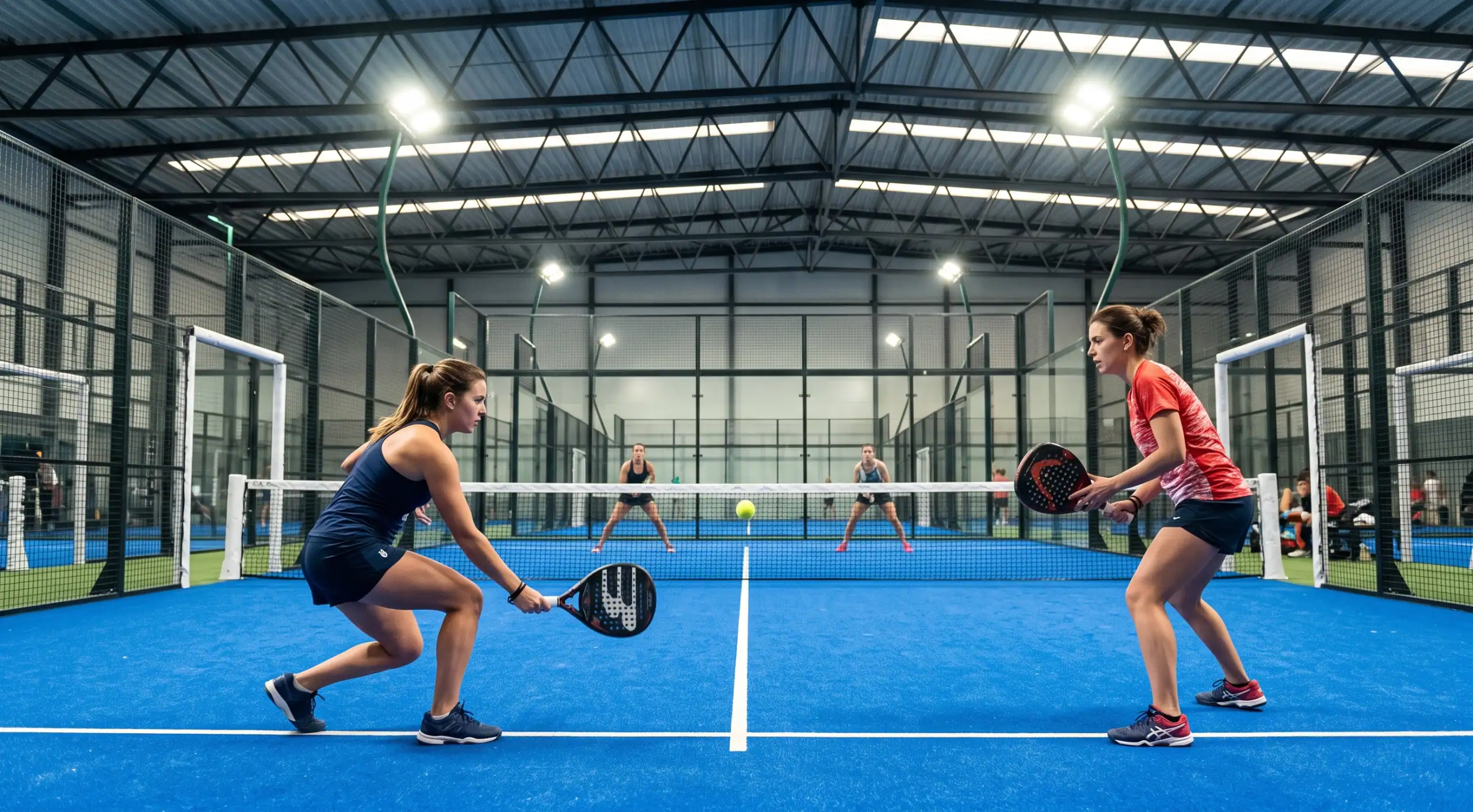
Six. That’s how many consecutive finals Arturo Coello and Agustín Tapia have won against Alejandro Galán and Federico Chingotto since the second week of June. It is the single number that explains why men’s padel’s most even rivalry on paper has stopped looking even at all, and it’s the backdrop to this week’s Premier Padel P2 in Düsseldorf, where the two pairs could meet again.
Düsseldorf is the middle leg of three straight European Premier Padel events, following Rotterdam and preceding Milan.
Düsseldorf hosts the second of three consecutive European Premier Padel tournaments, following Rotterdam, with the Oysho Milano Premier Padel P1 completing the series next week. The two pairs defending their titles in Germany are Fede Chingotto and Ale Galán among the men, and Delfi Brea and Gemma Triay among the women. Coello and Tapia, and Ari Sánchez and Andrea Ustero on the women’s side, arrive in strong form after back-to-back titles in Paris and Rotterdam.
The 2026 season, side by side
Ranking points in Premier Padel are earned per result and combined per pair for seeding purposes, with seeding based on FIP rankings, the top-ranked pairs receiving the most favourable bracket positions, and pairs seeded according to the combined ranking points of both players. On that measure, and on the raw season figures, the top two men’s pairs are closer than their recent results suggest.
| Metric (2026 season) | Coello / Tapia | Galán / Chingotto |
|---|---|---|
| Titles | 10 | 7 |
| Win-loss record | 62-7 | 64-10 |
| P1 titles | 4 | 4 |
| P2 titles | 3 | 3 |
| Major titles | 2 | 0 |
| Ranking points (post-Paris Major) | 20,526 | 18,331 |
Coello and Tapia have won nine tournaments in 2026 through late September, Galán and Chingotto have won seven, and the only other duo to win a title is Juan Lebrón and Leo Augsburger, who triumphed once in Brussels in April. A 6-3, 6-2 final victory over Franco Stupaczuk and Jon Sanz on October 4 gave Coello and Tapia their 10th title of the season, with Galán and Chingotto out after the quarter-finals in Rotterdam, so the title gap now sits at 10 to 7.
Win rate, the percentage of matches won out of matches played, tells an almost opposite story. Galán and Chingotto are 64-10 in 2026, with more match wins than any other pair on tour, while Coello and Tapia are 62-7. Both pairs have four P1 titles and three P2 titles; the entire difference comes from the Majors, where Coello and Tapia have won two while Galán and Chingotto have won none, and a Major awards 2,000 ranking points, double the 1,000 on offer at a P1.
So Galán and Chingotto have won more matches. Coello and Tapia have won the matches that carry the most weight.
Where the head-to-head turned
The two pairs have met in 11 finals this season, with Coello and Tapia winning seven. Spread that across the calendar and a clear split appears. Galán and Chingotto took early rounds of the rivalry, including the Gijón P2 final in March. But since the Italy Major on June 7, 2026, Coello and Tapia have won every final contested between the two pairs: Rome, Valencia, Valladolid, Bordeaux, London and Paris. Six finals, six wins, two of them Majors.

Reading the styles
The scouting picture from recent coverage of the pairs lines up with that split. For Coello and Tapia, the pattern is net control established early and finished with power. Serve and first volley establish quick net control, Coello finishes many apparently neutral balls from a high position, Tapia can accelerate a slow rally without warning, and their system holds up under major pressure.
That “high position” finish is usually a bandeja, a controlled overhead played without full power that lets the net player keep position rather than risk an attacking smash, or a full remate when the ball sits up enough to go for the point outright. Tapia’s change of pace typically shows up as a víbora, a smash sliced at an angle rather than straight down, or a chiquita, a soft, low shot aimed at an opponent’s feet that is hard to volley cleanly. Both shots are built to disrupt rhythm rather than end the point in one blow, which fits the “creativity and changes of pace” description of Tapia’s game.
Beating that system, on the scouting notes available, means working around it rather than through it. Opponents need to pin Tapia deep, move Coello away from the net with accurate lobs, and avoid offering short balls across long phases. That’s a specific, difficult task: Galán and Chingotto’s recent final defeats suggest it’s one thing to identify the plan and another to execute it for two sets against the tour’s most point-hungry pair.
Chingotto and Galán present a different profile built on defensive depth rather than first-strike pace. Chingotto defends exceptionally and keeps points alive, Galán creates finishing pressure from many court positions, both return aggressively and move as one unit, and their error rate stays controlled through long matches. That defensive base explains the win-loss gap: a pair built to grind out long rallies racks up match wins against the whole field, even in weeks when the very top opponent proves one rally too good.
Düsseldorf, unfinished business
The two pairs have specific history at this venue. Last year’s Düsseldorf final went to Galán and Chingotto in three close sets, their fifth title of the 2025 season and a career half-century of titles for Galán. Coello and Tapia arrive in Germany this week as top seeds and with the better 2026 numbers, but without a Düsseldorf title to their name.
The 2026 edition runs at Castello Düsseldorf from October 5 to 11, with total prize money of €264,534. Coello and Tapia opened as top seeds and were already through their first main-draw match by the Wednesday order of play, a routine start for a pair that has lost just seven matches all year.
The women’s picture is tighter still
If the men’s tour has a clear leader on the biggest results, the women’s game does not. Triay and Brea’s six titles came at the Gijón P2 and Cancún P2 in March, the BNL Italy Major in Rome in June, the Málaga P1 in July, the Pretoria P1 in August and the Madrid P1 in September, and they have reached 14 of the 17 finals played this season. Head-to-head against Bea González and Paula Josemaría, the two pairs have met in eight finals, with González and Josemaría winning five. Madrid also gave Triay a record of her own: she became the first player in Premier Padel history to reach 200 tour wins.
Into that logjam has stepped a pairing barely nine months old. Ariana Sánchez and Andrea Ustero have won three tournaments in 2026 and have timed their victories well, opening the season by beating Triay and Brea in the Riyadh P1 final in February and winning the Valencia P1 in June. On September 13, they won the Alpine Paris Major at Roland Garros 6-2, 6-0, with Sánchez, 29, controlling the final from the opening game. In that final, Ari Sánchez and 19-year-old Andrea Ustero were ruthless in a 71-minute win, and Ustero became the youngest Paris Major champion in history.
Rotterdam added a second straight title and a statement scalp. After winning the Major at Roland Garros, Sánchez and Ustero repeated the feat at the Dutch P2, defeating Delfi Brea and Gemma Triay 6-2, 6-3 in the semi-final. They then beat Bea González and Paula Josemaría 6-4, 6-4 in the final, a result that came the same week González and Josemaría were tied with Brea and Triay on six titles apiece for the season. Sánchez and Ustero’s own points total still trails the two pairs they just beat: Triay and Brea lead the points table on 16,974 each, with Sánchez third on 14,029.

What the numbers show, and what they might mean
The data shows a men’s rivalry where one pair wins more matches and the other wins more finals, and a six-final streak that lines up almost exactly with the calendar since the Italy Major in June. A likely reading is that Galán and Chingotto’s defensive, error-controlled style is enough to beat most of the tour but has not yet found an answer to Coello’s net finishing and Tapia’s pace changes when both are at their sharpest, particularly in best-of-three finals where there’s less time to grind an opponent down.
On the women’s side, the data shows three pairs separated by two titles and a handful of close finals rather than one dominant team. A likely reading is that Sánchez and Ustero’s rapid rise, built on a teenager’s net game paired with one of the sport’s most experienced competitors, has turned a two-pair race into a genuine three-way contest heading into the European autumn swing.
What to watch
In Düsseldorf, watch whether Galán and Chingotto can find three consecutive sets against Coello and Tapia for the first time since the Italy Major, rather than whether they can simply reach the final; their 2026 form says they’re capable of getting there. Watch too whether Tapia’s early rounds show the same shot selection credited with breaking rallies open all season, since Coello and Tapia’s win-loss record implies few opponents outside the very top have tested it.
On the women’s side, keep an eye on whether Sánchez and Ustero can make it three titles in a row, which would be their first appearance at that mark since pairing up in February, and on how Triay and Brea respond to back-to-back defeats to the same opponents in a semi-final and a head-to-head meeting. With three pairs separated by two titles, the next few weeks of the European swing carry more ranking significance than the raw results table suggests.
Sources
- Source: Chingotto-Galan and Brea-Triay defend their titles in Düsseldorf (International Padel Federation)
- Source: Premier Padel 2026 so far: the rivalries, players and subplots to watch (Red Bull)
- Source: Premier Padel: The battle for top spot in the world rankings (Red Bull)
- Source: Coello/Tapia and Sánchez/Ustero, Rotterdam P2 champions (Padel Addict)
- Source: How much Tapia-Coello and Sanchez-Ustero earned in Rotterdam (Tennis Tonic)
- Source: Ari Sanchez reaches the 100th final of an extraordinary career (International Padel Federation)
- Source: Germany P2 2026 — Premier Padel Results & Draw (StudyPadel)
- Source: Germany P2 (International Padel Federation)
- Source: Who will win Premier Padel Düsseldorf 2026? Contenders and teams (PadelGrid)
- Source: Ariana Sánchez (Wikipedia)
Excellent content